CASE NOTES
What makes a mystery puzzle fair-play: 4 rules we test every book against
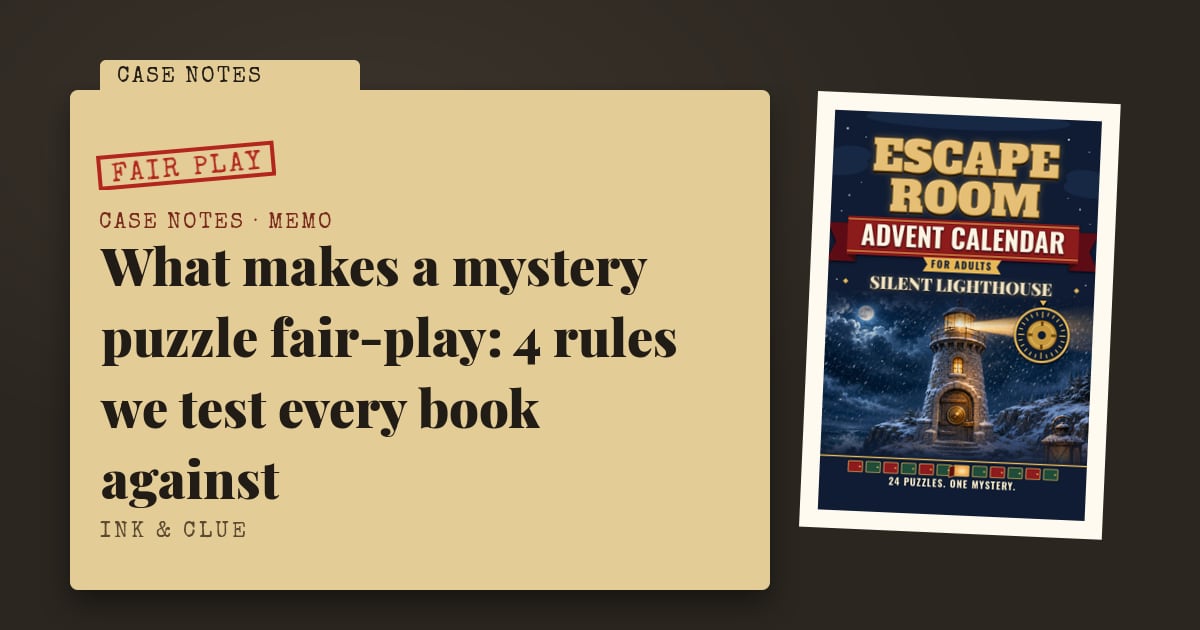
“Fair-play” is an old idea from detective fiction. The reader should be shown every clue the detective uses, so that — in principle — they could reach the solution first. A fair mystery can still be hard. What it can’t do is win by hiding something.
Puzzle mysteries take that idea one step further, because you aren’t just reading along. You’re writing answers in a grid, cracking a lock, naming a suspect. If the puzzle is unfair, you don’t just feel cheated at the end — you get stuck in the middle with no way forward.
Readers of puzzle mysteries tend to describe the same frustrations: clues that don’t add up, answers that need a leap nobody could make, and endings that come out of nowhere. So we wrote four rules, printed them as a memo on our home page, and test every book against them before it goes to print.
Rule 1: Every clue you need is printed in the book
No outside knowledge, no internet search, no “you’d know this if you’d been to Cornwall”. If a puzzle needs a fact, that fact is on the page: in the scene, in a document, on a map, in a note.
How we check it: when a puzzle is built, the solution is written down together with the steps that lead to it. Each step has to point at something the reader can actually see. A step that relies on “general knowledge” is a red flag and gets rewritten.
This rule also covers the small things — like a cipher whose key is hidden in the story. The key is never “obvious if you think about it”. It’s printed, and it’s findable. Our guide to using a cipher wheel shows what that looks like in practice.
Rule 2: Every puzzle has one answer, and we check it before print
This one sounds easy and is surprisingly hard. A sudoku with two solutions, a word search where a word appears twice, a logic grid where two suspects both fit — all of these feel broken to the person solving them, even if “our” answer is one of the valid ones.
How we check it: grid puzzles are checked by a separate solver that starts from a blank page and doesn’t trust the original. For a sudoku, it confirms the solution is the only one. For a word search, it confirms each word appears exactly once. For a logic grid, it confirms the clues lead to exactly one arrangement. For a lock or cipher, it confirms the decoding gives the answer and that the lock has exactly one code.
For story puzzles in an escape-room book, we check that each day leads to exactly one code. If a puzzle has two defensible answers, it goes back to the drawing board — not to the errata page.
Rule 3: Hints come one at a time
Getting stuck is part of the fun. Being stuck for an hour isn’t. The answer is a ladder of hints, where each step gives a little more away, and you choose how far down to go.
How we check it: the first hint should point you at the right evidence without telling you what it means. The last hint should make the method clear while still leaving the final step to you. The full solution sits separately, so you never see it by accident while flipping for a hint.
On this site, every puzzle has its hints in sealed envelopes. The second envelope only opens after the first. It’s the same idea in digital form: you decide how much help you want.
Rule 4: The finale uses what you found earlier
A good mystery ending feels inevitable in hindsight. Nothing appears out of nowhere at the last minute. In a puzzle mystery, the cleanest way to make that true is to build the ending out of answers you’ve already earned.
How we check it: we trace every answer in the book forward. Where does it come back? An early answer that never matters again is a wasted clue. A final puzzle that needs something the reader was never given breaks rule 1.
In our December case, early doors feed later ones. That’s why the puzzle pages remind you to keep your answers.
What fair-play doesn’t mean
Fair doesn’t mean easy. A fair puzzle can take real thought, and some of our later days are meant to. Fair doesn’t mean every red herring is labelled, either. Misdirection is allowed — as long as the true clues are also on the page and the misleading ones can be ruled out with what you were shown.
Judge for yourself
The simplest way to see if we keep our own rules is to play a case. Day 1 of the Frostmere case is free on this site, with two sealed hints if you need them. If you think we broke a rule, we’d genuinely like to hear about it.
And if you’re new to day-by-day puzzle mysteries, start with how an escape room advent calendar works.
MORE CASE NOTES
How to use a cipher wheel (with a free Day 1 puzzle)
A plain-English guide to the cipher wheel puzzle: how the two rings work, how to set the key, how to decode a message, and a free puzzle to try it on.
Escape room advent calendar for adults: how a day-by-day puzzle mystery works
An escape room advent calendar turns December into one long case: a door a day, a code behind each one. Here is how it works and how to get the most out of it.