CASE NOTES
Escape room advent calendar for adults: how a day-by-day puzzle mystery works
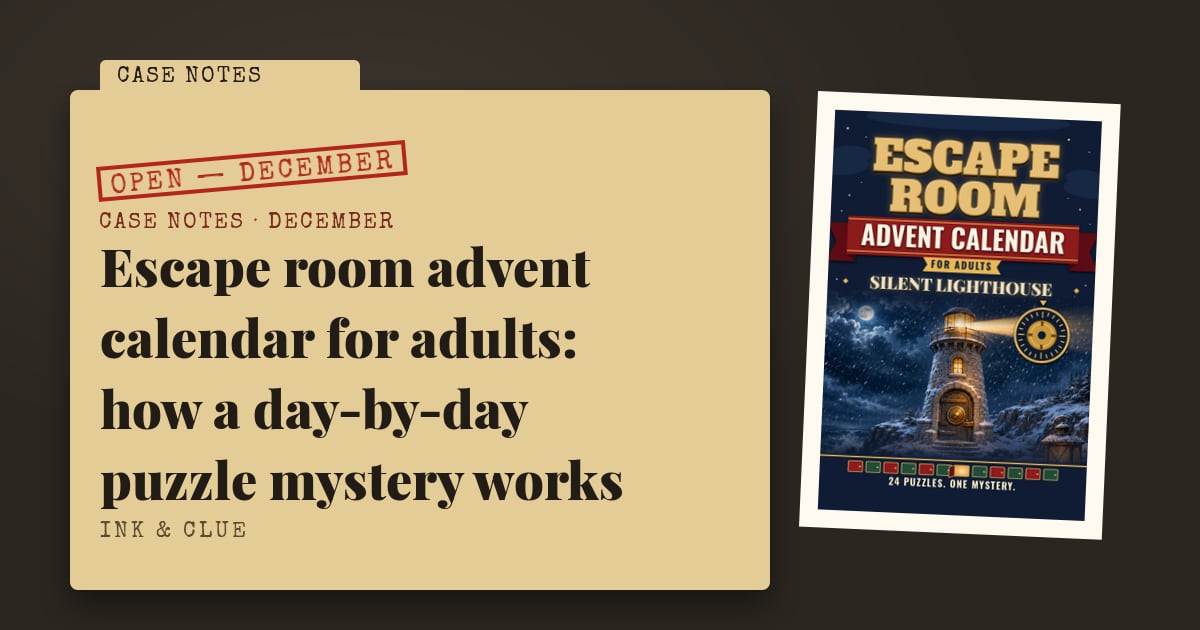
An ordinary advent calendar is over in seconds: open a door, eat the chocolate, done. An escape room advent calendar for adults asks for a few minutes of thinking instead. Each day you open one “door”, solve what’s behind it, and move one step further into a story that only makes sense by the end of the month.
If you’ve never tried one, this guide explains how the format works, what kinds of puzzles to expect, and a few habits that make the whole month more fun.
The basic idea
The book is one case, split into days. Every day has three parts:
- A short piece of story. Something happens. Someone says something odd. A new document turns up.
- A puzzle. A lock to open, a note to decode, a suspect to rule out, a map to read.
- A code. Solving the puzzle gives you an answer — a number, a word, a name. That answer is your proof that the door is open.
Then you stop for the day. The next door waits for tomorrow.
The difference from a regular puzzle book is the thread running through it. In a collection of unrelated puzzles, each page stands alone. In a puzzle mystery, the days are connected: something you notice on an early day can matter much later, and the last days often ask you to use answers you’ve already earned.
What kind of puzzles are inside
Escape-room puzzles borrow from real escape rooms, where you’re locked in with a pile of objects and need to work out which ones matter. On paper, that tends to mean:
- Ciphers — a note in code and a tool to decode it, like a cipher wheel.
- Locks — a combination hidden in an object, a date, a count of things in a picture.
- Logic — who was where, and when. Timetables, statements, alibis that don’t line up.
- Visual searches — a scene or a map where the answer is in plain sight, if you look properly.
- Wordplay — anagrams, hidden words, first letters.
A good calendar mixes these up, so no two days in a row feel the same, and gets harder as the month goes on.
How to play it well
Keep a case notebook. Write down every answer, even when the book doesn’t tell you to. In a connected mystery, an early answer can be a key later on. Most “I’m stuck” moments in the last week turn out to be “I didn’t write that down”.
Don’t skip ahead. It’s tempting to peek at tomorrow’s door. Resist it. The story is written to be read in order, and later pages can give away earlier solutions.
Use hints in order. Good puzzle books give you a ladder of hints instead of the answer straight away. Take one step, then go back to the puzzle. You’ll be surprised how often the first hint is enough.
Start any day you like. “Advent” suggests 1 December, but nothing stops you starting earlier, catching up on a weekend, or doing two doors on a quiet evening. It’s your case.
Play together if you want. These books work for one person with a cup of tea, but they’re also good for couples or a family table — one person reads the story aloud, everyone argues over the evidence.
Is it fair?
A day-by-day mystery only works if every puzzle can actually be solved with what’s on the page, and has a single answer. That’s the most common complaint about puzzle mysteries, and the main thing we test for. We’ve written up the four fair-play rules we check every book against, if you want to know what to look for — in our books or anyone else’s.
Try a door before December
Our first December case is set at a lighthouse cut off by a blizzard, where the lamp went dark at twenty minutes to midnight and the keeper has vanished. A few of its doors are open on this site, free, with sealed hints if you get stuck.
Start with Day 1 on the Frostmere case page. If you enjoy it, the rest of the doors are in the book.
MORE CASE NOTES
How to use a cipher wheel (with a free Day 1 puzzle)
A plain-English guide to the cipher wheel puzzle: how the two rings work, how to set the key, how to decode a message, and a free puzzle to try it on.
What makes a mystery puzzle fair-play: 4 rules we test every book against
Fair-play means you could have solved it from what you were shown. Here are the four rules we hold every Ink & Clue case to, and how we check them.